🐿️ Squirrel for Mayor
Unearthed documents show the use of the word “NIMBY” in BC government publications.
Development Approvals Process Review (DAPR, 2019)
Direct quote:
“Public hearings can enable NIMBY (an acronym for ‘not in my backyard’) which describes residents’ opposition to a development in their own neighbourhood, while raising no objections to similar developments in other neighbourhoods.”
The Development Approvals Process Review (DAPR, 2019) is a provincial Government of British Columbia report that examines how local governments approve development projects. It identifies barriers to faster housing delivery—such as lengthy timelines, regulatory complexity, and public hearing processes—and recommends reforms to streamline approvals. The report places particular emphasis on improving efficiency, reducing delays, and addressing what it characterizes as unrepresentative or obstructive public input, including opposition framed as “NIMBY,” ultimately informing later policy and legislative changes such as the removal or limitation of public hearings.
Public Hearings Removed: Who Gets to Speak Now?
Public hearings—the one place where anyone, whether a tenant or a homeowner, can stand up and speak directly to decision-makers—are being reframed as a problem.
And the justification comes down to one word:
“NIMBY.”
Who Was at the Table?
In the Development Approvals Process Review (2019), industry voices are well represented.
Community voices are not.
The only easily identifiable community groups included:
- Burquitlam Community Association
- Saanich Community Association Network (SCAN)
On Vancouver Island, the Saanich Community Association Network (SCAN) is an umbrella group that brings together representatives from multiple community (neighbourhood) associations within the District of Saanich, British Columbia. It is not a single neighbourhood association, but part of its community association network.
In 2019, SCAN participated in drafting the Development Approvals Process Review (2019) when its Chair, who is a construction professional, contributed input on behalf of all Saanich neighbourhood associations during a process that would ultimately recommend limiting public hearings.
- SCAN appears to operate with minimal public-facing infrastructure (e.g., a Gmail contact)
- Despite this, it appears that they may receive funding from the District of Saanich
This raises two basic questions:
Did every neighbourhood association in Saanich agree to discuss the challenges to public hearings, framed as a means of enabling NIMBY participation? Or was this participation without quorum?
Who was actually representing the public when the public’s main avenue for participation was being restructured?
Excerpt: 4.2b Public Input Process (DAPR 2019)
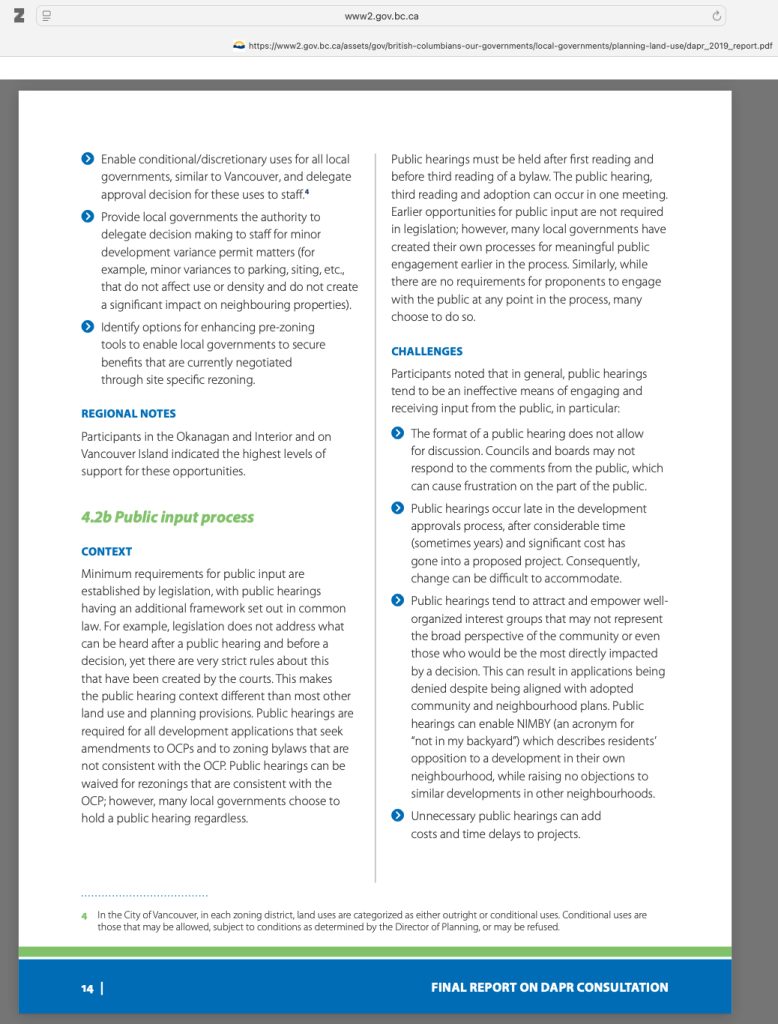
https://www2.gov.bc.ca/assets/gov/british-columbians-our-governments/local-governments/planning-land-use/dapr_2019_report.pdf Accessed March 31, 2026
And Who Replaces the Public?
Housing advocates often argue that public hearings:
- Only attract a certain type of participant
- Do not reflect the broader population
- Are dominated by organized voices
But what replaced the opportunity for public input?
At a public hearing, both “sides” are participating. While affected parties in a development area may not be organized in the same way as formal groups, regular citizens used to make time to speak—especially when facing eviction, for example. “But now, tenants are more desperate and more willing to fight to stay in their housing because there are fewer affordable options, and the loss of housing can trigger what has been described as a “catastrophic spiral” in someone’s life. At the same time, there is a persistent assumption that displaced residents will be absorbed into non-profit or subsidized housing, yet that safety net is increasingly difficult to access as funding is reduced and availability shrinks” (Times Colonist). Meanwhile, third-party advertising groups (which assist political candidates in getting elected on like-minded policy grounds) are highly organized and act as political actors, even though they are not required to identify themselves as such.
The argument, then, is not about participation—it is about which participation is legitimized.
NIMBY is defined as explicitly localized opposition to development, which is then used to justify limiting or reforming public hearings. Squirrel for Mayor had attended many public hearings, both in person and online, before they were effectively made illegal in 2023 by provincial legislation (Bill 44), which removed decision-making at the local level. The first thing that came to mind was that the Mayor and Councillors will never have to feel guilty about approving a development if they never see tenant tears again—especially in the City of Victoria, where 62% of the population rents.
The reality is that many who support these policy changes are the same people running for municipal office who knock on your door promising to help with affordable housing, yet once in office, approve the demolition of your affordable home to build more housing units and to assist more residents with deeper pockets.
Bill 44: From Recommendation to Law
The public input process for DAPR 2019 is the type of consultation that informs the law. The public is usually told that any consultation is extensive. What is framed as a “process improvement” in policy documents then becomes legislation.
Through Bill 44 (2023), the Province of British Columbia removed the requirement for public hearings for housing developments that are consistent with Official Community Plans (OCPs).
Then each municipality was forced to update their OCP to conform with Bill 44.
Under Bill 44:
- Projects that align with pre-approved zoning and OCPs can proceed without a public hearing.
Public input is expected to occur earlier in the planning process, rather than at the point of decision.
But in practice, this shifts participation to stages that are:
- less visible
- less accessible
- and often before the full impacts of a project are understood
Concerns about the erosion of public process are not limited to planning policy. Environmental law organization Ecojustice has also warned that efforts to accelerate approvals in British Columbia risk “cutting corners” and weakening environmental safeguards. In reviewing proposed expedited environmental assessment processes, Ecojustice highlights how streamlining timelines and reducing scrutiny can compromise both ecological protection and public accountability. This mirrors what is happening in land use planning: when efficiency is prioritized over thorough review and meaningful participation, the result is not just faster decisions—but decisions made with fewer safeguards for ecosystems and communities alike.
For tenants, this is particularly significant.
Older, more affordable rental housing is demolished and replaced with higher-density buildings at significantly higher rents or purchase prices. Tenants are displaced, often with little ability to influence the outcome—or future outcomes—by drawing the Mayor and Council’s attention to how a change in policy is playing out on the ground.
A policy that considers place-based planning with compassion and care tends to be more empathic to ecological systems as well. Because place is not abstract—it is lived, inhabited, and interconnected.
The same conditions that produce tenant displacement—erasure of existing relationships, disregard for what is already there, prioritization of efficiency over continuity—are mirrored in how ecological systems are treated. Garry oak ecosystems, for example, are not empty or underutilized land waiting for improvement; they are complex, co-evolved communities that have developed over thousands of years through Indigenous agroecological land management. When planning processes remove meaningful public input, they also remove the local knowledge, stewardship, and lived awareness that make these systems visible. In this way, the framing of opposition as “NIMBY” does not just silence people—it risks silencing the ecological realities those people are trying to speak for.
Is “NIMBY” Appropriate Language for Government Policy to Describe Its Citizens?
A final question – is it now acceptable for the BC government to use the term “NIMBY” in official publications? The word is widely understood to be pejorative—used to dismiss community concerns as selfish or narrow—rather than to neutrally describe them. It introduces a defensive tone into what should be objective public policy, and risks collapsing legitimate issues—like tenant displacement, infrastructure capacity, safety, or ecological loss—into a single, dismissive category. It also creates an “us vs. them” dynamic that undermines meaningful public engagement. While the term may appear in academic contexts, its use in government documents raises serious questions about neutrality, respect, and whether public input is being understood—or eliminated.
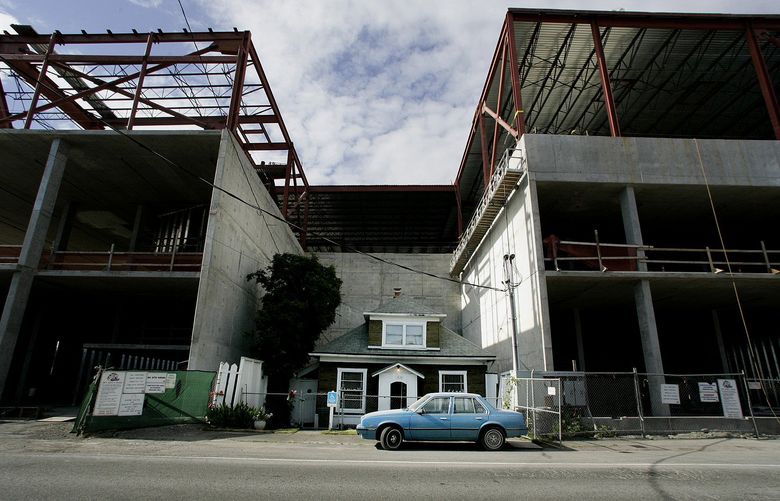
Arguably one of the most famous “NIMBYs” in popular culture is based on a real person. The animated film Up modelled its central house on Seattle’s Whitewood Cottage—also known as the Edith Macefield house. According to the Seattle Times, “she became a cause célèbre, a little old lady who said no to big developers.” Edith, who would undoubtedly be described today as exhibiting “NIMBY” tendencies, managed to hold her ground and, in doing so, preserved a small piece of place—including a single tree. One can imagine that an urban squirrel may have shared that space with her as well.
Resources
The DAPR report and NIMBY Toolkit were provided by Sasha Izard as items found during his research revealing the government of BC operating against the public interest for private corporate interests.
Government of British Columbia. Development Approvals Process Review: Final Report. 2019,
https://www2.gov.bc.ca/assets/gov/british-columbians-our-governments/local-governments/planning-land-use/dapr_2019_report.pdf
Government of British Columbia. NIMBY Toolkit. Province of British Columbia, n.d.,
https://www2.gov.bc.ca/assets/gov/housing-and-tenancy/tools-for-government/uploads/nimbytoolkitvfin.pdf
Cadboro Bay Residents Association. “Eric Dahli to Be Recognized by Shawn Newby, Chair of SCAN in Saanich for Dedicated Service.” Cadboro Bay Residents Association, 18 Feb. 2019,
https://cadboro.ca/2019/02/18/eric-dahli-to-be-recognized-by-saanich-for-dead/
District of Saanich. “Community Associations.” District of Saanich, n.d.,
https://www.saanich.ca/EN/main/community/community-associations.html
Ecojustice. “Cutting Corners to Fast-Track B.C. Is at Risk of Compromising Environmental Safeguards with Proposed Expedited Environmental Assessments.” Ecojustice,
https://ecojustice.ca/news/cutting-corners-to-fast-track-b-c-is-at-risk-of-compromising-environmental-safeguards-with-proposed-expedited-environmental-assessments/. Accessed 3 Apr. 2026.
“Edith Macefield.” Wikipedia, The Free Encyclopedia, Wikimedia Foundation,
https://en.wikipedia.org/wiki/Edith_Macefield. Accessed 3 Apr. 2026.
“Eviction Saga Highlights Effect of Treating Housing as Commodity: UVic Prof.” Times Colonist,
https://www.timescolonist.com/local-news/eviction-saga-highlights-effect-of-treating-housing-as-commodity-uvic-prof-12089925. Accessed 3 Apr. 2026.
“Squirrel for Mayor.” Historical Use of Nimby. Urbanists vs. the NIMBYs: District of Saanich Special Council Meeting for Draft Quadra McKenzie Plan, July 7th, 2025, 2025,
https://www.garryoakecosystem.com/2025/07/urbanists-vs-the-nimbys-district-of-saanich-special-council-meeting-for-draft-quadra-mckenzie-plan-july-7th-2025/